Roy Freeman
The Book of MirrorsRoy Freeman is a former detective whose return to the Joseph Wieder murder case turns an old investigative failure into a race against forgetting. At once a seasoned investigator and a man confronting early-stage Alzheimer’s disease, he is driven not only by the possibility of solving the murder but by a personal need to account for the damage he believes his past mistakes caused.
Identity and Background
Freeman lives in Bergen County and has been divorced from Diana for many years. They were married for almost twenty years and had a son, Tony, whom Freeman hardly saw after Diana and their son moved to Seattle following the divorce in the late 1980s. By the time Freeman discusses his family with John Keller, Tony has graduated from college and works as a news anchor at a local radio station. Freeman’s later stay at his ex-wife’s home in Seattle is temporary, a retreat from the reporters who descend on him after the case attracts public attention.
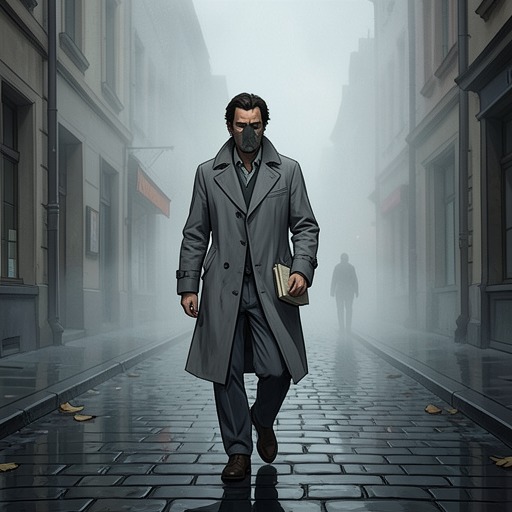
In appearance, Freeman is tall and thin, with nearly all-white hair and a carefully trimmed beard covering the lower half of his face. Keller sees him as resembling a dependable supporting actor: someone who backs up the central figure rather than seeking attention for himself. That impression suits Freeman’s understated manner, but the apparently steady former detective is also carrying personal regret, health concerns, and a sense that his earlier career did not always live up to its responsibilities.
The Original Investigation
Freeman worked on the investigation into Joseph Wieder’s murder in the late 1980s. Richard Flynn admitted being at Wieder’s house on the night of the killing but said he had left hours before the murder. Freeman recalls that Flynn was interviewed several times without the police finding grounds to challenge his account. The inquiry also reached Laura Baines: Freeman says the police knew about the possibility that she and Wieder were involved, but could not prove an affair. He interviewed her, and her alibi for the evening seemed strong; a female schoolmate was understood to have confirmed it.
Derek Simmons, the handyman and another witness, was a less straightforward source. Years later, Freeman cannot remember precisely what Simmons declared. He recalls Simmons as ill and amnesiac, and regards the statement as too unreliable to establish much beyond gossip. Freeman also says that the police had no proof of a relationship between Baines and Wieder, while her alibi weighed against her having been at the scene. His account shows how the investigation treated both testimony and personal relationships as matters that required corroboration, even as its confidence in Simmons’s mental condition helped diminish the value assigned to his evidence.
Returning to the Case
The case re-enters Freeman’s life through an inquiry into Flynn’s missing manuscript. At a meeting with Keller in a restaurant on West 36th Street, Freeman hears that Flynn wrote about the period and sent a book to a literary agent, but that most of the manuscript cannot be found. Keller explains that he has been hired to reconstruct the facts and has spoken to numerous people without finding a concrete answer. Freeman responds by bringing him a large buff-coloured envelope of copied agency records. Because the agency’s records had not been computerized until the early 1990s, Freeman had to search through boxes in the archive; the papers are not classified, and he is able to copy them for Keller.
Freeman later returns to the investigation for reasons that are both professional and personal. After learning about Frank Spoel’s confession, he wants to hear Spoel’s account directly rather than accept the confession at face value. Freeman is suspicious: Spoel had been released from a mental institution shortly before Wieder’s murder, and Freeman wonders whether he may have heard about the killing and confessed because he wanted attention after learning that an author was interested in the case. With help from Matt Dominis, a veteran at Potosi Correctional Center, Freeman arranges a visit before Spoel is scheduled to be executed. He wants to see Spoel himself and hear his account of the West Windsor murder.
Freeman brings a carton of Camels to the prison visit, knowing cigarettes function as currency there. He has not smoked for fifteen years, but follows Matt’s advice; prison staff must inspect the carton, so he tells Spoel he will receive it after Freeman leaves. Spoel says that he has no one on the outside, has not seen his parents in more than twenty years, and is frightened by the prospect of dying in four weeks. He then admits killing Wieder, while distinguishing the intention he claims to have had from the outcome: he says he meant to beat Wieder, not kill him. Freeman’s interview therefore gives him a confession to test, not a conclusion he is ready to accept.
Conflicting Accounts and Memory
Freeman’s own recollection of the night does not match Spoel’s. Spoel says he watched Wieder’s house from the backyard and saw the professor with a young man, whom Freeman suspects was Richard Flynn. Spoel insists that no young woman was there. Freeman challenges the account by emphasizing the snowfall and Spoel’s concealed position, but Spoel remains certain. Freeman also points to the timing of Wieder’s death: the professor survived for two or three hours after the attack, and someone entered the house later, yet did not call an ambulance. Spoel maintains that he heard someone unlock the door and walk inside. The later visitor and the choice to leave Wieder dying remain questions in their conversation, rather than details Freeman can resolve from Spoel’s testimony alone.
Freeman’s own version is challenged too. Derek Simmons had told Keller that both Flynn and Baines were present, that an argument took place, and that Baines’s car was later parked nearby. When Keller sets this against Spoel’s account, the contradictions are specific: Simmons places Baines at the house, while Spoel says nothing about her; Simmons recalls an argument, while Spoel recalls none; and both accounts place their tellers in or near the backyard at the same time. Freeman suggests Spoel may have forgotten or lied, but Keller is increasingly inclined to suspect Freeman. The competing statements expose the limits of treating any one witness’s confidence as proof, including Freeman’s own recollection.
Freeman’s urgency comes into sharper focus when he reveals that he has early-stage Alzheimer’s disease. His doctor has advised him to keep his mind active and provided a book and videos for exercises. Freeman says he has perhaps one to three years before he may no longer remember who Wieder was or that he was a police officer. He had thought he had failed the case because he was, in his own assessment, a lousy drunk. Revisiting the murder gives him something he considers more meaningful than exercises based on old ball games: a chance to understand how he let the murderer escape and to clear up the mess he believes he made. Keller tells him that the department respected him and considered him a good man who did his duty, while acknowledging that Freeman liked to drink. The reassurance does not erase Freeman’s self-reproach, which remains a central motive for his renewed investigation.
Resolution and Aftermath
Freeman ultimately confronts Derek Simmons and records his confession; Simmons is arrested. The revelation gives the case a decisive public resolution, and Freeman becomes a media figure, celebrated in headlines as the ex-detective who solved a twenty-eight-year-old murder mystery. The attention is so intrusive that he temporarily moves into Diana’s Seattle home to get away from reporters. His return to a case he once believed he had mishandled thus ends in recognition, but not uncomplicated vindication: his earlier conclusions and Simmons’s account had left crucial questions unresolved until the renewed inquiry brought them back into view.
The case also changes what the missing manuscript means to those around it. Peter learns from Keller that the latest events have overturned Flynn’s theory and shown how the author’s imagination had embellished real events. For Freeman, however, the public exposure is only one consequence of the solution. His effort to investigate before his memory fails has been an attempt to make sense of an old professional failure; after the arrest, the same story that had occupied him begins to recede as he reconnects with Diana and hears about their son, daughter-in-law, and granddaughter.